

Why more designers are turning to CMU for performance, predictability and long-term value
By Tino Kalayil, P.E.
The building design industry is shifting. The cost of construction is critical. Labor and schedule drive costs, and designers need to begin to consider this during design. As structural engineers, we typically design to final condition but need to begin to design with holistic cost in mind, not just material cost. The cost of a wall system may be driven by how fast you can build it – and due to this, we are seeing a trend to delegating systems and leaving it in the hands of the specialty engineer and contractor to dictate that.
For years, concrete masonry wasn’t really part of that conversation. But that’s starting to change. Masonry has typically been part of the engineer of record scope. However, we are seeing masonry fall back in university education, leading masonry to be more of an afterthought. The gap between designing and understanding holistic costs of concrete masonry systems has grown, resulting in the need to push for different means of design delivery.
The Concrete Masonry Checkoff (CMC) has launched the Block Design Collective (BDC), a virtual destination where architects, engineers and contractors (AECs) can access free CMU project support and design assistance. Accessible at blockdesign.org, the BDC is built to address design challenges nationwide across diverse climate conditions. Our team of regional technical directors is backed by a network of experienced consultants, all focused on helping designers determine where and how concrete masonry can advance performance goals while staying within budget.
Delegated Design
A significant way to improve project delivery and outcomes is through delegated design, also known as assisted design. Michigan’s experience with concrete masonry (CMU) walls demonstrates the success of this approach. By collaborating with the Masonry Institute of Michigan (MIM), local design and construction teams were able to streamline schedules, reduce expenses, and enhance performance, all while keeping the core design team focused on the overall project vision. This method allows specialized engineers to take responsibility for specific components, ensuring they are optimized for constructability and code compliance.
In construction projects, delegated design allows a specialized structural engineer to handle detailed design elements for specific components, such as CMU wall assemblies, while the Architect of Record and Engineer of Record maintain oversight. This approach optimizes technical details like reinforcement and moisture control for constructability and code compliance, leading to reduced overdesign, lower material costs, and improved project efficiency by minimizing delays and RFIs.
Delegated design is a strategic approach that enables engineers to create tailored solutions for CMU walls that are both resilient and efficient, by adapting to specific regional demands. This not only eliminates unnecessary costs and complexities but also streamlines the design process by defining responsibilities, simplifying choices, and sharpening the technical details. The result is a more efficient CMU system that delivers its full potential on every project.
Driven by Innovation
One of the big trends we’re seeing is the increased expectation that structural engineers deliver more than just load paths. Owners and GCs want complete wall systems handled upfront, including coordination, code compliance and constructability. Delegated design is no longer an exception; it’s becoming standard practice on many projects.That’s pushing the industry to step up. On the masonry side, we’ve seen major movement—whether it’s early-phase design support through the Block Design Collective, access to BIM-integrated wall assemblies, or just better documentation and guidance to help engineers navigate the process.
We’re also seeing growth in prefabrication strategies. More producers are offering pre-blended mixes, consistent modular units, or shop-finished CMU that tightens up sequencing. That kind of flexibility matters when you’re trying to shave time off a schedule without losing control in the field.
Compared to Other Wall Systems
When you’re evaluating a wall system from a structural lens, you’re not just looking at strength—you’re looking at how well it integrates with everything else happening on the job. Here’s where CMU sets itself apart:
- Built-in fire resistance: Standard 8″ CMU walls can achieve 2- to 4-hour fire ratings without additional finishes or protection. That’s reliable passive protection that remains structural during and after fire exposure.
- Hollow cells: CMU’s inherent design serve as natural chases for reinforcement and MEP, reducing the need for framed interior walls or additional routing strategies. This simplifies detailing and minimizes trades coordination.
- Thermal mass: According to DOE data, thermal mass wall systems like CMU can reduce peak heating and cooling loads by up to 40% in commercial buildings, contributing to comfort and passive survivability.
- Seamless foundation integration: CMU’s unit dimensions align with typical foundation widths, allowing full-height assemblies without bump-outs or eccentric loading—a benefit especially in retrofit or low-clearance projects.
- Wind uplift, lateral loads, and out-of-plane pressure: CMU meets or exceeds structural requirements in IBC and TMS 402-22 for high wind and seismic regions. It’s also one of the few materials cited in FEMA P-361 and ICC 500 for tornado and debris impact resistance
Scalable for Any Project Type
Concrete masonry continues to serve a critical role across sectors—especially when structure and envelope need to work together.
- Industrial + Warehouse
CMU is well-suited for industrial and warehouse environments where durability, impact resistance, and passive fire separation are required. Reinforced masonry walls can achieve 2- to 4-hour fire ratings without additional finishes and withstand the physical demands of equipment vibration, forklift traffic, and long-term wear—reducing maintenance over time. - Multifamily + Mid-Rise Housing
For 3- to 7-story multifamily or mixed-use projects, CMU offers a load-bearing solution that also delivers on fire and acoustic separation between dwelling units. Masonry assemblies simplify floor-to-floor alignment, reduce reliance on steel framing, and support efficient layout for stairwells, corridors, and vertical shafts. - Civic + Exterior Envelope Applications
In schools, health clinics, and public facilities, CMU provides a resilient exterior envelope that stands up to weather, wind, and impact without layered systems. It supports energy efficiency goals through thermal mass, enables integral finishes that eliminate the need for cladding, and meets debris impact resistance requirements outlined in FEMA P-361 and ICC 500 for tornado-prone regions.
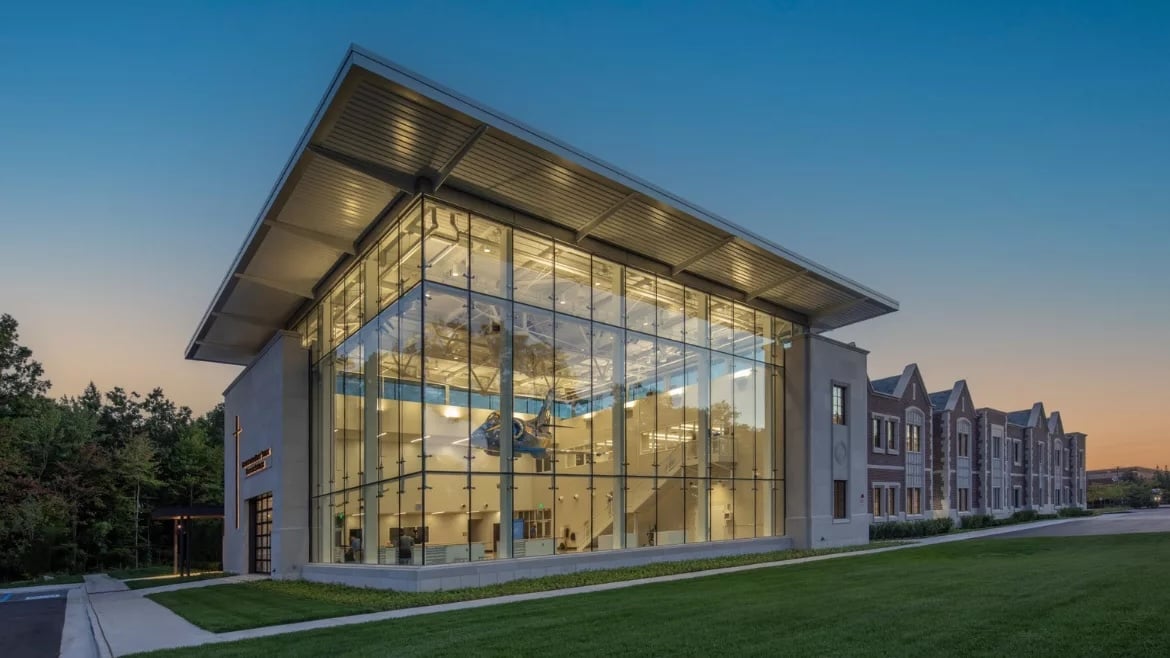
George and Mary Turek Hall of Science — Detroit Catholic Central High School, Novi, Michigan
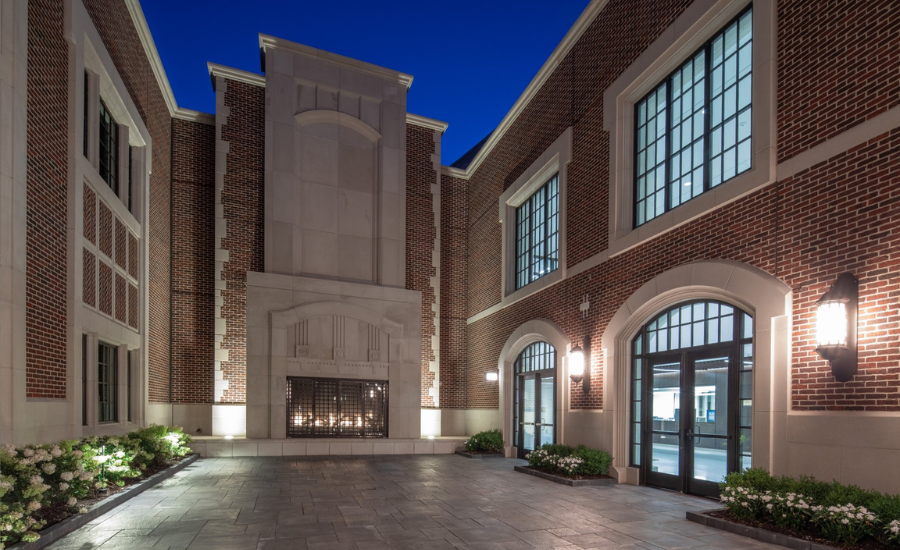
The George and Mary Turek Hall of Science redefines how concrete masonry can perform in contemporary learning environments. The 57,000-square-foot STEM addition pairs the permanence of masonry with a bright, transparent design vision. Concrete masonry units (CMU) serve as both the structural core and interior finish, eliminating extra layers while enhancing efficiency and visual continuity.
Ground-face CMU anchors the two-story cavity wall system, with its finished surface turned inward to define the classrooms. The patterning of full- and half-height units creates subtle texture and rhythm, reflecting light from adjoining glass walls and lending warmth to the learning environment. The double wythe wall assembly provides a resilient, low-maintenance envelope—ideal for a century-old institution that values longevity and stewardship.
Home to a full-scale robotics arena featuring a suspended Blue Angels jet, an observatory, greenhouse, esports suite, and advanced fabrication labs, the facility demonstrates how CMU’s strength and versatility support both structural and aesthetic ambitions. Built while classes remained in session, the project proves masonry can meet demanding timelines and design goals while standing as both structure and statement in modern educational design.
Material Choice Matters
At the end of the day, architects, engineers and contractors want systems that do their job under pressure. Concrete masonry gives you that. It’s predictable. It’s resilient. And it’s already aligned with the way we design and build.
If you haven’t looked at CMU lately, now’s a good time. The tools, the guidance, the support—they’re all in place.
You don’t have to figure it out alone. Explore technical resources and project support at www.BlockDesign.org